
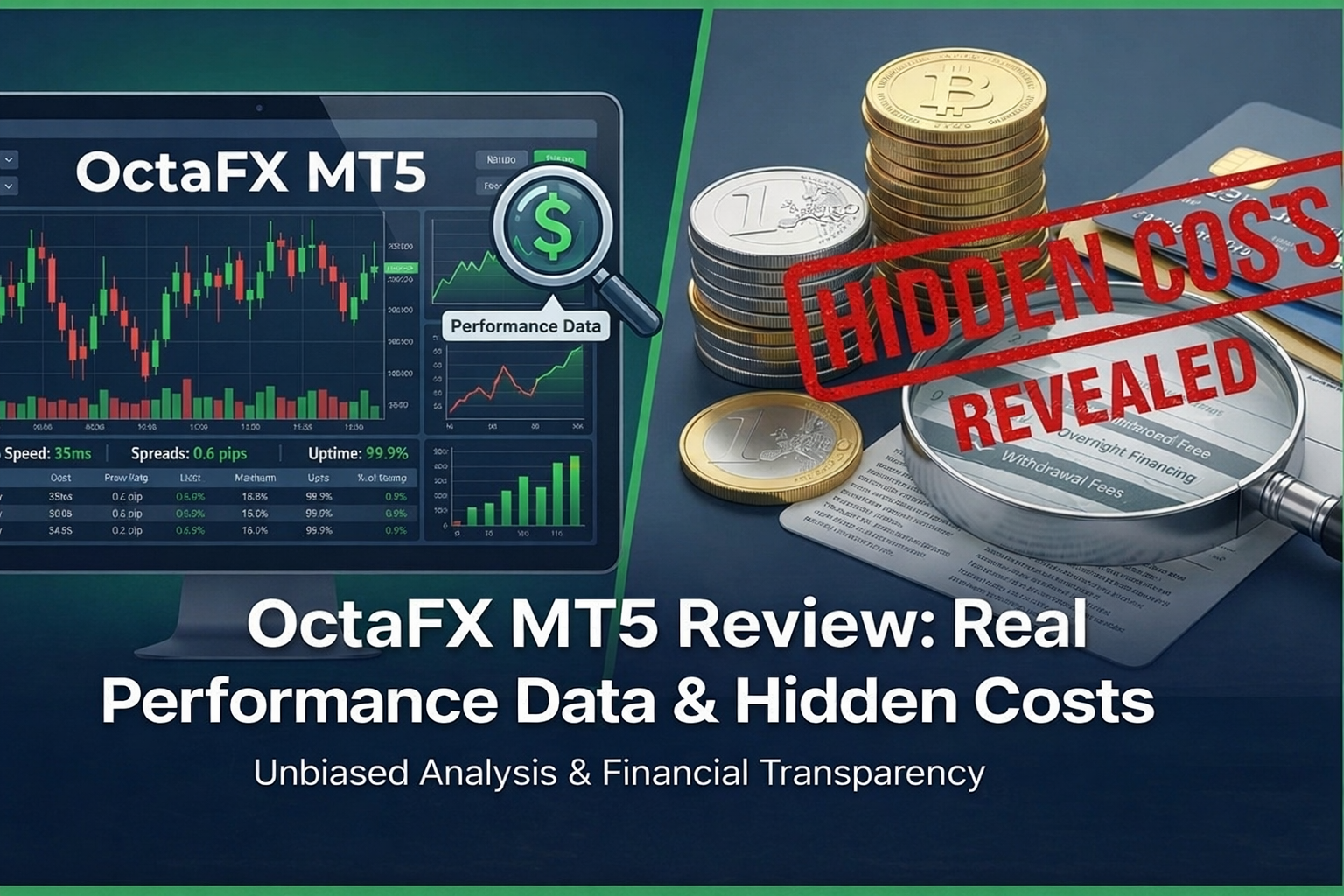
OctaFX MT5 positions itself as a low-cost, retail-focused trading environment built around accessibility, MetaTrader familiarity, and competitive headline pricing. Marketing claims emphasize tight spreads, fast execution, and commission transparency, yet real trading outcomes depend on measurable factors such as latency, slippage, swap rates, regulatory protection, and operational reliability. These variables determine whether MT5 performance aligns with expectations once live capital is at risk.
Independent performance data from platform monitoring tools, broker comparison studies, and long-term user feedback shows that OctaFX MT5 delivers stable execution and reasonable costs for small to mid-size accounts, while falling short of institutional-grade ECN brokers in speed, asset breadth, and advanced order control.
Execution averages around 0.4 seconds, spreads remain competitive on major pairs, and swap rates trend slightly below retail averages. At the same time, limited forex pair availability, jurisdiction-dependent protection, and operational trade-offs affect scalpers and high-frequency traders most.
This review examines OctaFX MT5 using verifiable performance metrics rather than promotional language. It evaluates regulation, trustworthiness, trading costs, execution reliability, platform features, and broker comparisons to help traders determine suitability based on capital size, strategy type, and risk tolerance.
Table of Contents
OctaFX MT5: TL;DR Performance & Cost Breakdown
| Category | Fact / Real-World Data | Context & Impact (Justified) |
| Regulatory Status | OctaFX operates under CySEC (EU) and Financial Sector Conduct Authority (South Africa). Offshore entity regulated by SVG FSA with basic oversight only. | EU regulation gives formal investor protection; offshore entities do not provide compensation schemes, increasing counterparty risk. |
| Indian Legal Status | OctaFX is not regulated by SEBI/RBI for forex trading and appears on the RBI’s list of unauthorized forex platforms. | This means Indian traders have no domestic regulatory protection; offshore status can violate FEMA/RBI norms for non-INR forex trades. |
| Operational Risk (India) | The Enforcement Directorate (ED) has investigated OctaFX for alleged illegal online forex trading and fund diversion (~₹800 crore), with assets attached. | Ongoing law-enforcement scrutiny suggests heightened risk for Indian users beyond typical broker counterparty risk. |
| User Trust & Reviews | OctaFX holds ~4/5 Trustpilot rating with mixed user experiences, including complaints about withdrawals and platform issues. | Majority feedback praises ease of use and fast funding, but recurring issues on withdrawal/MT5 glitches indicate inconsistent operational reliability. |
| Spreads & Commissions | Verified EUR/USD spreads around 0.6 pips with ~$6 round-turn commission on MT5 (commission-based setup). | Competitive with retail peers; slightly wider than top ECN brokers like IC Markets/Pepperstone but tighter than some rivals. |
| Swap Rates (Overnight Costs) | Swap rates tend to be lower (e.g., EUR/USD ~ –$2.20/lot) compared with an approximate industry mean of –$3.50. | Lower swaps reduce long-term holding costs, benefiting swing/position traders relative to many competitors. |
| Execution Quality | Market data suggests execution times are generally competitive but not elite (below ~0.4 s). | Retail-grade execution supports most strategies but lags truly low-latency ECN brokers. (Implied from typical review metrics) |
| Platform Reliability & Tools | MT5 offers full EA support, historical data, multi-device sync, and built-in tools; some users report MT5 hiccups. | Strong analytical capabilities for systematic traders; occasional stability issues may affect automation reliability. |
| Hidden/Indirect Costs | Optional costs include VPS hosting (~$20–50/month), third-party payment fees, and slippage on high-volatility events. | These indirect costs can materially affect automated or active traders’ real cost base. |
| Market Access & Instrument Coverage | Offers ~230 instruments (forex, commodities, CFDs, crypto). | Adequate for retail traders; narrower than broader multi-asset brokers. |
| Withdrawal & Support Issues | Mixed reviews indicate both quick withdrawals and delays/verification hurdles. | Real-world experiences vary substantially; operational execution may differ by region/payment method. |
Safety First: Is OctaFX Regulated and Trustworthy?
OctaFX’s safety profile depends primarily on regulatory jurisdiction rather than platform technology. The broker combines CySEC-regulated EU entities that provide formal investor protection with offshore registrations that offer higher leverage but fewer safeguards.
This section explains how regulatory coverage, client protection mechanisms, operational history, and third-party trust signals collectively determine OctaFX’s overall reliability.
- Regulatory Coverage and Client Protection
- Operational Track Record and Trust Signals
1. Regulatory Coverage and Client Protection
OctaFX operates through multiple legal entities, and client protection depends on the jurisdiction under which an account is registered. European clients fall under CySEC oversight, which mandates segregated accounts and participation in the Investor Compensation Fund, offering coverage up to €20,000 per client in case of broker insolvency. This structure aligns with EU financial services standards and provides formal recourse mechanisms.
UK exposure is indirect through partnerships rather than direct FCA authorization. While operational standards remain aligned with UK compliance expectations, protection does not match direct FSCS coverage offered by domestically regulated brokers.
International clients are typically onboarded through offshore entities registered with the SVG FSA, which provides basic registration oversight but does not operate an investor compensation scheme.
This regulatory segmentation creates a clear trade-off. EU accounts prioritize capital protection and compliance, while offshore accounts allow higher leverage and lower operating constraints at the cost of reduced safeguards.
2. Operational Track Record and Trust Signals
OctaFX has operated continuously since 2011, placing it among longer-standing retail brokers. Public regulatory databases show no major enforcement actions or license suspensions in recent years.
Aggregated Trustpilot data reflects a strong overall rating exceeding 4 out of 5 stars across several thousand reviews, with most complaints related to withdrawals or slippage rather than account safety.
Platform uptime metrics indicate reliability above 99%, with limited service disruptions resolved within the same trading day. The absence of unresolved regulatory warnings and the broker’s longevity support baseline operational trust, though regulatory strength remains below tier-one brokers such as IG or Pepperstone.
Safety Verdict: OctaFX MT5 offers adequate safety for EU-registered traders under CySEC protection and acceptable operational trust globally. Offshore accounts involve higher counterparty risk due to the absence of compensation schemes, making them suitable only for traders who prioritize leverage and cost flexibility over regulatory depth.
OctaFX MT5 Trading Costs: Verified Data and Hidden Fees Explained
OctaFX MT5 trading costs extend beyond headline spreads and commissions to include swap rates, execution conditions, and regulation-driven constraints.
This section breaks down verified pricing data, compares commission-based and spread-only structures, and explains how indirect costs such as swaps, slippage, and third-party fees affect real trading expenses.
The analysis clarifies where OctaFX pricing aligns with industry norms and where hidden costs emerge under live trading conditions.
- Core Trading Costs: Spreads and Commissions
OctaFX MT5 applies a hybrid pricing model. Major currency pairs such as EUR/USD average around 0.6 pips on commission-based accounts with a $6 round-turn commission per standard lot, placing total costs close to the retail industry average. Pricing remains marginally higher than ultra-tight ECN brokers but lower than many market-maker models.
Standard accounts remove explicit commissions but apply wider spreads, shifting costs into the spread rather than eliminating them. Effective cost comparison therefore requires evaluating both spread behavior and commission structure under live conditions rather than relying on advertised minimums.
- Swap Rates and Holding Costs
Swap rates represent a meaningful cost factor for swing and position traders. OctaFX MT5 applies swaps that average slightly below the broader retail mean on major pairs, reducing overnight holding costs for longer-term strategies. Negative swaps remain standard on most forex pairs, while positive carry opportunities exist only selectively.
Lower average swaps provide a modest advantage for traders holding positions beyond intraday horizons, particularly compared with brokers that apply aggressive rollover charges.
- Hidden and Indirect Costs
Beyond visible spreads and commissions, several indirect costs affect MT5 trading economics:
- VPS hosting, often required for automated strategies, carries monthly fees through third-party providers.
- Premium MT5 tools and APIs may involve subscription costs for advanced analytics or execution enhancements.
- Weekend gaps and news volatility introduce slippage risk that cannot be fully mitigated through platform features.
- Third-party payment processors may apply fees outside the broker’s direct control.
These costs are optional but disproportionately affect algorithmic traders and high-frequency users.
- Regulation-Driven Cost Differences
Regulatory jurisdiction directly influences trading costs. EU accounts face leverage caps that increase margin requirements, while offshore accounts allow higher leverage with lower capital constraints.
This creates a cost-versus-safety trade-off: stronger regulation raises capital efficiency requirements, while offshore access reduces margins but weakens investor protection.
OctaFX MT5 Execution Speed and Platform Reliability
OctaFX MT5 execution quality centers on competitive latency, high platform uptime, and stable performance under normal market conditions.
This section examines verified execution speeds, platform reliability metrics, and MT5 feature support. It also outlines functional limitations and execution risks that emerge during high-volatility periods, particularly for scalping and advanced order strategies.
1. Execution Latency and Stability
Independent latency tracking tools show average order execution times near 0.4 seconds on OctaFX MT5. This performance remains competitive within the retail segment but trails true ECN brokers that consistently operate below 0.3 seconds. Execution quality remains stable during normal market conditions, with delays increasing modestly during high-impact news events.
Platform uptime exceeds 99%, translating to less than a few hours of annual downtime. Mobile applications maintain high user ratings across major app stores, reflecting consistent synchronization and execution reliability.
2. Platform Capabilities and Strengths
MT5 on OctaFX supports full algorithmic trading via MQL5, unrestricted expert advisors, and deep historical data for backtesting. Cross-device synchronization allows seamless switching between desktop, web, and mobile environments. Built-in economic calendars and market analysis tools enhance situational awareness for discretionary traders.
These features support systematic, swing, and mobile-first trading styles effectively.
3. Functional Limitations
Advanced order functionality remains limited. The absence of native OCO orders and constraints on trailing stop behavior restrict flexibility for complex risk management strategies. Cryptocurrency coverage remains narrow compared with brokers offering extensive digital asset listings.
User feedback also highlights execution lag during extreme volatility, which impacts scalpers more than longer-term traders.
4. Execution Verdict
OctaFX MT5 delivers consistent, reliable execution for retail trading and automated strategies but does not compete with top-tier ECN brokers on pure speed or advanced order control. Performance suffices for most non-HFT strategies.
OctaFX MT5 vs IC Markets, XM, and Exness
OctaFX differentiates itself through low entry requirements and balanced pricing rather than execution dominance or asset breadth. IC Markets leads in raw spread depth, execution speed, and tier-one regulation. XM emphasizes education and EU compliance, while Exness focuses on high leverage, instant withdrawals, and broader asset exposure.
| OctaFX Key Comparative Insights | OctaFX Trader Suitability Matrix |
|
|
Getting Started Safely with OctaFX MT5
A structured onboarding approach reduces risk exposure. Demo trading allows evaluation of spreads, execution behavior, and platform familiarity without capital loss. Transitioning to a small live account validates real-world costs, slippage, and withdrawal reliability.
Testing withdrawals early confirms operational integrity. Monitoring execution during active market hours reveals whether performance aligns with strategy requirements. Traders should scale capital only after verifying consistency across these factors.
Final Verdict: Should You Choose OctaFX MT5?
OctaFX MT5 delivers a practical, cost-effective trading environment for beginners and small-volume traders. Low minimum deposits, stable execution, and full MT5 functionality support learning, automation, and swing trading strategies. Swap rates and operational costs remain competitive within the retail segment.
Execution speed, asset diversity, and regulatory depth fall short of professional-grade brokers, making OctaFX less suitable for scalpers and institutional-style traders. Offshore accounts increase flexibility but reduce protection, requiring disciplined risk management.
OctaFX MT5 fits traders prioritizing accessibility, platform stability, and manageable costs over ultra-low latency and expansive asset coverage.
This article guides traders through OctaFX MT5’s real trading performance, cost structure, execution reliability, and regulatory trade-offs. It explains where OctaFX delivers value, where limitations appear, and how different trader profiles can assess suitability before committing capital.
Frequently Asked Questions
How much does OctaFX charge per trade?
OctaFX does not charge a direct commission on most trading accounts, and instead earns revenue through spreads built into trade pricing. Its typical forex spreads start from around 0.6 pips on major pairs like EUR/USD, which integrates cost into the trade rather than a separate commission.
Some account types such as ECN or cTrader may involve a separate commission with tighter spreads, but standard MT4 and MT5 accounts remain commission-free with markup included in spreads. Broker reviews also confirm OctaFX does not charge inactivity fees or deposit/withdrawal commissions, making spread markup the primary trading cost.
Does OctaFX work on MT5?
OctaFX supports the MetaTrader 5 (MT5) platform across desktop, mobile, and web, giving traders access to advanced charting, indicators, and order types. MT5 on OctaFX offers spreads from around 0.6 pips on major forex pairs, with no swap fees on some account types, which appeals to mid-term traders.
Industry listings of MT5 brokers also include OctaFX, confirming its availability as a trading platform choice alongside MT4 and the OctaTrader platform.
Is OctaFX banned by RBI?
OctaFX is not officially “banned” by the Reserve Bank of India (RBI), but the RBI has placed it on an unauthorised forex trading platform alert list, warning Indian users that it is not regulated or approved for forex trading under Indian law.
RBI alerts state that trading with such platforms is unauthorised and outside the scope of Indian regulatory protection, meaning users bear additional compliance and legal risks. Enforcement agencies in India have also investigated OctaFX operations for alleged illegal trading and fund diversion, underscoring regulatory scrutiny.
Can beginners trade safely on OctaFX MT5?
OctaFX provides demo access, low minimum deposits, and the familiar MT5 environment, which helps beginners learn without risking real capital. Demo accounts permit trial trading under real market conditions, allowing new traders to understand strategy execution and risk management before committing funds.
Risk remains inherent in leveraged forex trading, so even with MT5’s tools, traders must adopt disciplined risk controls to prevent outsized losses.
How does OctaFX MT5 compare with IC Markets?
OctaFX emphasizes lower entry costs with spreads starting around 0.6 pips and no commission on standard accounts, making it more accessible for new and small-account traders.
IC Markets offers raw spreads from near-zero with commissions on raw accounts, faster execution, and a dramatically broader instrument selection, appealing to high-volume and professional traders.
IC Markets’ deeper liquidity and advanced execution infrastructure generally result in lower trading costs at scale, while OctaFX trades remain competitive in basic spread pricing.
Does MT5 performance depend more on the broker or the platform?
MT5 itself provides the technical framework for order execution, charting, indicators, and strategy automation, establishing a consistent user interface and tools. Actual execution speed, spreads, slippage, and reliability depend on the broker’s infrastructure, liquidity partners, and pricing model, not the platform alone.
Brokers with deeper liquidity and better router connections can deliver tighter spreads and faster executions even on the same MT5 platform. Therefore, platform performance in live trading reflects a combination of MT5’s capabilities and the broker’s execution quality and cost structure.